November 08, 2006

Punjab History finding its place on cyberspace


On October 30 and 31, Prof. R. K. Khanna had posted two articles about the Punjab History. They are "Maharaja Ranjit Singh’s relations with Kangra" and "Lord Hardinge’s Policy towards the Punjab".

I believe that these two articles augur good for the History of Punjab. There is a general complaint that there are no good sources on Indian history available online. There is truth in this contention. One does not find material especially primary sources on Indian history online. There are many articles on Indian history, but there are reservations about the nature of their contents from the historic perspective. However, now there are two more articles on Indian history and regional history of India.

I showed my happiness when Prof. Khanna started posting his articles. Here I stand justified in my stand. I now hope that he will continue to bring similar write ups on regular basis in spite of his physical ailments.

Khanna has not quoted the sources while writing these articles. He had done it earlier but not this time. On the other hand, his article on relation between Lahore Darbar and Hill Kings is more important. It justifies my stand of rewriting the history of India. During the 1800s there were three main powers which could have given a fight to British power. The first one was the Mysore Kingdom. Then it was the Peshwas and the third one was Maharaja Ranjit Singh. However, in the history books, Lahore Darbar had been shown as an upstart. It is an interpretation which had been presented by the British historians. They had already decided a story line and argument sequence from which the latter historians had never tried to break themselves away. I am unable to understand and accept the argument that the British were using Ranjit Singh as a bulwark firstly against Napoleon and latter against Russia. This line of argument has tried to suggest that the British could have easily gulped the Lahore Darbar. But they feared the advance of French and then Russians towards East. Therefore, they found Maharaja Ranjit Singh as a good and enough strong wall against them. On the other hand, for them, he was nothing. Such an argument lacks on many grounds. But this is how this argument is being preserved and nurtured throughout.

In the above mentioned article, Prof. Khanna has rightly studied the relations between the Lahore and Hill rulers on one hand and between Hill rulers and the Nepal on the other. These forces were such that the East India Company could have not beaten them easily had they made even a single confederacy. The company knew it. However, it goes to the credit of the company that they took time to design and decide their strategies before taking over the rule of this area. The history of India as they wrote then, was what they saw and desired to achieve and finally got it done in reality. They had never told that what they feared. They had always what they desired to to do and how they had done. Why explaining that, they talked about the weakness of the Indians only. Similarly, the role of Awadh, Hyderabad and Bengal had never been studied from Indian perspective. Whatsoever had been presented by the British historians, that had been taken as the debating point and then the debate had been given the status of a nationalist version of history. This is the main shortcoming of the history of India. Different scholars and historians had presented this contention in different words but the actual truth is that the history of India is never written as it should have written for India as a country and a nation. The articles similar to these ones, appear only as research papers. Sometime, they get printed as a compilation in form of an edited book. But they have never left their impact on the established narration of history of India as such. If one reads such articles, he develops different perspectives. The readers of such articles undergo the sensation of understanding the India of present. But when such readers read the history of India as such, they feel the shock. They feel that there are many threads which remain untied. There are many gray areas which demand explanation because the present does not vouch for the history as being told about India. The insistence upon presenting a peculiar definition of secularism in India has left a highly mutilated version of India as a whole.

Anyhow, let us hope that Prof. Khanna may continue to bring out on the cyberspace similar type of articles and present a fresh view of the Indian history in the manner in which he had presented in the two articles. Secondly, he may also bring out the sources referred and cited in his article. That would make this exercise more useful. He is already the author of seven books by now. He may later bring his work in the print. Here, he can share his findings and views with the online community which luckily consists of many established historian as well as teachers and also many amateur historian and interested readers of historians like Siddhartha Shome, an engineer.

November 03, 2006

Defining Americanism in the 21st Century


It is not an essay. It is mainly an introduction to a web site. It is rather a link on a web site. The main web site is Unites States Information or International Information Programs of US Department of State, as the site is being desired to be called. The link site is Writers on America.

The motive of the site can be well expressed in the words as given on the web site itself. It follows.

"This book originated as an intriguing suggestion by Mark Jacobs, a U.S.
foreign service officer with our State Department staff who also happens to be a
working novelist. If we were to ask a contemporary group of American poets,
novelists, critics, and historians what it means to be an American writer,
Jacobs proposed, the results could illuminate in an interesting way certain
America values -- freedom, diversity, democracy -- that may not be well
understood in all parts of the world.


In the spirit of trying an
experiment, that is what we did. Choosing 15 writers who have attained a certain
stature for their work, with the group as a whole reflecting the considerable
diversity of American writing today, we commissioned each to write an essay. The
assignment: In what sense do you see yourself as an American writer?
"


The way it is presented, even a casual looker may not escape from getting attracted to its contents. However, it is depicted in a very innocuous manner in the list of the products of its mother site. It is titled as the Writers on America. It may escape the attention of the visitor to the main site. In case, the visitor activates the link, he will never move away without reading the contents.

I was looking for the original documents on American history. The American government as well as American universities have used Internet in a more meaningful manner. They have understood the real meaning of Information and Communication Technology and every now and then, they are bringing new models to exploit the potential of this technology for the benefit of the humanity. Without such efforts, this technology seems to be a mere toy. Without such experiments, it may be reduced to a place where you see some sign boards of some companies as you see them on the road. You may be using it for online registration, online booking of tickets, online banking, online trading, online news and similar works but that may not continue to bind the users for a longer period. Soon something more will come and the visitors will move on. But, by making it a store house of authenticated information and documents, a true democratization of knowledge, a real freedom through dispersion of knowledge and information, and a continuous medium of learning, the medium is made meaningful for humanity for all times to come. It is not only Americans who are realizing the potential of this medium in a true manner. The similar activities are also seen in case of European countries also. If an impression can be taken for established fact, then whatsoever can be discerned by the email listing of H-Net, even the Japanese and Chinese are also doing this.

Anyhow, it was when I was looking out for the original documents on American history, I stumbled upon this site. As the quoted lines above, as taken from the site itself, can convey, it attracted my attention. It was really a novel experiment. The result is also really amazing. This experiment is there since December 2002. There are 15 stalwarts of American literature of present times and all have different origins but now a common place of residence. They have spoken out with freedom and in the process defined the America of the twenty first century. They are 15 Reflections on the America as it is being felt and lived in 21st century.

I have read the essays only by three writers by now. It has left me with highly ennobling feelings. I have written on each of these three writers. I have picked lines from their essays. I here reproduce the lines by Bharati Mukherjee.

"I'm far more impatient with hostility from Indian and India-born American scholars in "post-colonial" disciplines who instinctively disparage anything with an American provenance. (Their mantra seems to be that if America or the West in general set themselves up as the pinnacle in social and political evolution, then it is the duty of all children of colonialism to oppose them "asymmetrically," that is, in any way they can.)" Bharati Mukherjee

The lines may not convey much to a non-Bharati (Indian) but if an Indian can come out of his complexes and biases, he can appreciate and admire the truth conveyed in the lines of Ms Bharati Mukherjee. I have written my impressions on reading such lines. But I am not able to weave them into a good essay. The introduction to the Web site is rather more effective essay on the content matter of this experiment which has given birth to this site. I have kept back all those lines which I have written but I have given it a title as "Defining Americanism in the 21st Century". I believe that sums up the true theme of this site. Or to quote from the introduction, "America refracted through these writers' minds is not one place but many."

I hope and believe that other readers would also find it interesting.

October 23, 2006

Talking to a Doyen


It is more profitable to listen to a doyen than to read a book. It may be a sweeping statement. It is used here to start a talk.


When you read a book, it may take four to five days. After you complete a reading, you just receive a scratch on your mind. You receive an impression about the subject matter on which a book is written. However, you take more than forty to fifty hours to complete a book. The final result is that you develop a scanty idea about a concept or theme. If you like to keep the book or buy a personal copy, mostly it is because there is good bank of data on an event, a personality or a trend.


When you talk to a doyen, you learn more than you can learn from a book. The doyen delivers to you a refined content and final verdict. He gives more than what you can learn from a reading of a book.


I talked to Prof. J. K. Sharma, an expert on Buddhism and Ancient History with Panjab University, Chandigarh. It was a general talk. However, even during the talk, I learnt more than I could have learnt by reading three to four books. We talked on a telephone for merely 29 minutes. There was lost of personal talks. Even then, I am left with more learning than what I could have done by reading a book for 29 hours. Let me share it with rest of the world.


D. D. Kosambi is considered as a leading historian of India and pioneer of many trends in Indian historiography. However, he was an amateur historian. He was a mathematician by training and received his degree from Harvard University. He desired to undertake a specializing but failed to receive scholarship. He remained back in India and ventured in to field of History.


In history, he introduced the device of statistical conclusions. He became the first Marxist Historian in true sense. He used his understanding of mathematics in using statistical devices to present his conclusions in the subject of history. On the basis of his study of history, he gave the thesis of thematic periodization. He criticized the dynastic periodization of Indian history. The trend he started him later became the dominating theme of historic research in India.

He was a polyglot. He knew nearly eleven languages.

He had written four books and nearly fifty plus research papers. The OUP has published a combined book on Kosambi which includes all his works.


Meera Kosambi is her daughter. She is an expert in Sociology. She had contributed to the historiography of gender studies.


Finally, the trend of transporting the foreign models to Indian history and history study is still going on. The Chola period is being study with different perspective only because a theory of fragmentary empire is being borrowed from African history and fixed over the achievements of the Chola period in Indian history. This is the bane of Indian history. The Indians have not be able to develop any authoritative theory in the field of history. As I understand, it is also true in case of Indian Economy and Indian Sociology. The Gandhian Trusteeship is considered non-feasible option. Nehru brought mixed economy model. The experts in the field tried to convince every that it was the best answer at that time. Nehru framed his Public Private Sector economic planning on the basis of his socialism. The Indians were taught the lessons of saving and spending less. But nineties brought the open economy model. The expert now changed the tone of their ragas. They convinced us that it is the panacea for the health of the country. The mixed economy and license raj was the bane of Indian economy. The world is changing so we have to change. But what about the basic ratios of Indian economy and society. The class and caste divide is still. The people suffers due to illiteracy, lack of health services and poverty surrounded by rising malls and extending flyovers. This is all due to importing of intellectual models and weakness of Indian intellectual to bring out Indian models built on Indian given ground realities. One or two D. D. Kosambis are not enough. We need more Kosambis in field of social sciences.


The above impression received as scratches after merely talking for 29 minutes with a doyen.


Edited: Date: October 23, 2006: Added information.


Note: I stand responsible for the above views.

Additional sources on D. D. Kosambi:
Added on October 23, 2006:

Read the books by D. D. Kosambi online at Arvind Gupta Toys and his team. (Move Down the list to locate the books which are in PDF.)

Bhupinder Singh has also collected online sources on Blogspot site and Geocities Sites (They actually take you to Arvind Gupta work. Here it is acknowledged that the online books as given by Arvind Gupta was located through the posting of Bhupinder Singh.

K. M. Shrimali, another noted historian writes a review on the OUP book on D. D. Kosambi on Frontline

A. L. Basham had paid a personal Tribute to Baba in R. S. Sharma Edited ICHR Journal.

Dr. (Mrs.) Jyotsna Kamat write about Acharaya Kosambi the father of D. D. Kosambi on the family portal Kamat Potpurri.

Neutral Observer had recently reviewed the book "An Introduction to the Study of Indian History" a classic book by D. D. Kosambi.

Wikipedia has nothing much over an above than that could be collected from above sources. The article writer has used the online resources only to write it, something which I have done in many articles posted here.

October 22, 2006

A Case Study on Development of Functional Meaning of the Gazetteer


The Gazetteer literally means a geographical index or at the most a geographical dictionary. However, gradually, it acquired a character, that imparted it a status of an important recorded source in the field of history. Herein, the meaning of gazetteer is studied as it developed in colonial British India and post Independence India. It is not an exhaustive work. It is merely a commentary on a preface of a gazetteer which is made available online. However, the contents as extracted from there, make a good essay and qualify the title of this write up. The source is the activity undertaken by the Gazetteers Department of the Government of Maharashtra, and reported online. Therefore, it is mere a case study and not a complete analysis as such.

British Administrative Motive:

This is an extract from a circular of 1843, issued in the Bombay Presidency to the collectors of the districts. It reads as follows:
"Government called on the Revenue Commissioner to obtain from all the Collectors as part of their next Annual Report the fullest available information regarding their districts….. ….Government remarked that, as Collectors and their Assistants during a large portion of the year moved about the district in constant and intimate communication with all classes they possessed advantages which no other public officers enjoyed of acquiring a full knowledge of the condition of the country, the causes of progress or retrogradation, the good measures which require to be fostered and extended, the evil measures which call for abandonment, the defects in existing institutions which require to be remedied, and the nature of the remedies to be applied. Collectors also, it was observed, have an opportunity of judging of the effect of British rule on the condition and character of the people, on their caste prejudices, and on their superstitious observances. They can trace any alteration for the better or worse in dwellings, clothing and diet, and can observe the use of improved implements of husbandry or other crafts, the habits of locomotion, the state of education, particularly among the higher classes whose decaying means and energy under our most levelling system compared with that of preceding governments will attract their attention. Finally they can learn how far existing village institutions are effectual to their end, and may be made available for self-government and in the management of local taxation for local purposes."
(Extract quoted in Gazetteer of the Bombay Presidency, vol. I, Part I (History of Gujarat), pp. iii. and iv.)

It is further reported there that "In obedience to these orders reports were received from the Collectors of Ahmedabad, Broach, Kaira, Thana and Khandesh. Some of the reports contained much interesting information. These five northern reports were practically the only result of the Circular Letter of 1843."


It is further reported there that nothing further seems to have taken place after the above mentioned activity. On the whole, in the year 1843, it was believed that the main source of the information were the district administration officers who moved around among the people in the region. They were identified as the right people to report the data and then that data had to be processed and provided to the next future officers.


In the meantime the Gazetteer for the Central Provinces of British Indian Empire was completed in the year 1867.

The Secretary of State of India desired in 1867 that the Presidency of Bombay should also prepare the Gazetteer of the Bombay Presidency as a similar record had been prepared for Central Indian Provinces. The Bombay Presidency appointed a Bombay Gazetteer Committee in year 1868. It was directed to ‘supervise and direct the preparation of the Gazetteer’. Finally, Mr. James M. Campbell of Bombay Civil Services was entrusted the responsibility of the Bombay Gazetteer Committee. Mr. Campbell started the work of compilation in 1874. He completed the work of compilation by the year 1884. The work of the publication of the compilation started in year 1877 and continued up to the year 1904. It took 27 years to complete the work of the publication. In the year 1904, the General Index volume was published. It had 27 volumes and on the whole 35 books including the General Index Volume. The number of books increased over the number of volumes because some of the volumes had more than one book.


Definition of Gazetteer

The Gazetteer literally means a geographical dictionary or a geographical index. However, in practice, the contents of a Gazetteer underwent a tremendous change. A study of development of the change of the actual meaning and contents of a gazetteer makes a good story and a case.

The British Imperial administrators grappled with the problem of providing the right information to the people whom they entrusted with the responsibility of running the administration of a districts as the collectors of the administrative unit in the Bombay Presidency. The authorities sought the solution in getting a gazetteer ready for that purpose. It raised the demand on their part to understand the actual importance and usability of such a compilation. They sought the opinion of the their expert. The opinion and practical advice was given by Sir William Hunter, Director General of Statistics to the Government of India. His guidance and opinion was sought in case of preparation of Gazetteer for Dharwar District in year 1871. It was sought to get into the core understanding on the purpose which a gazetteer was intended to service. Sir William Hunter gave the following opinion.

"My own conception of the work is that, in return for a couple of days’ reading, the Account should give a new Collector a comprehensive, and, at the same time, a distinct idea of the district which he has been sent to administer. Mere reading can never supersede practical experience in the district administration. But a succinct and well conceived district account is capable of antendating the acquisition of such personal experience by many months and of both facilitating and systematising a Collector’s personal enquiries………But in all cases a District Account besides dealing with the local specialities should furnish a historical narration of its revenue and expenditure since it passed under the British rule, of the sums which we have taken from it in taxes, and of the amount which we have returned to it in the protection of property and person and the other charges of civil government." (quoted in Gazetteer of the Bombay Presidency, vol. I, Part I, (History of Gujarat), pp. vii.)


Hence, it was just a reversal of the meaning of the purpose of the collection of a required data to be compiled as a gazetteer. In the circular of 1843, it was deemed right to collect the data from the collectors themselves, because they had the first hand information about the area. They were considered right people for the source of such information because of the requirement of the services required them to move around the district and come across the reality at ground level. They were the people at the front. Hence, the data collected thus was meant for the use of the government and for the future district administration. Now, when the gazetteer was being prepared in 1868, firstly the meaning of the term was modified and altered. Secondly, it was also identified that it should only be such document which would gave a distinct idea of the districts and nothing more than that. It is quite an understandable conclusion. The district collectors had to work on the day to day basis and by the time he reached his posted place, the new changes took place. For the colonial government, there were other restrains also.


Post Independence Activity:

In 1949, the Government of Bombay, (at that time, reorganization of the states had not taken place.) felt the need of up to date gazetteer. Therefore, it was decided that the old Gazetteer of Bombay Presidency should be revised and republished by making it up to date. An Editorial Board was established for that purpose. The Editorial Board completed its works in year 1854 under Mr. M. R. Palande, Executive Editor and Secretary, Editorial Board.

The Editorial Board of the Government of Bombay contributed to the nature of the Gazetteer after they acquired it in their hands. The Editorial had its own opinion and views. The Board was now an office of the Government of the Republic of India which is a secular country. This was reflected in the opinions and views of the Board while undertaking the activity of the work of the revision.

The board found that in the older gazetteer that "There are portions in the old Gazetteer bearing on archaeology and history which have the impress of profound scholarship and learning and their worth has not diminished by the mere passage of time. Even in their case, however, some restatement is occasionally necessary in view of later investigations and new archaeological finds by scholars, and an attempt has been made to incorporate in this edition the results of such subsequent research."

Then Board was also fully aware of the its own status in 1949. It wrote, "In a dynamic world, circumstances and facts of life change, and so do national requirements and social values. Such significant changes have taken place in India as in other countries during the last half a century, and more so after the advent of Independence in 1947. The general scheme and contents of this revised series of the Gazetteer have been adapted to the needs of the altered conditions. There is inevitably some shift in emphasis in the presentation and interpretation of certain phenomena. For example, the weighted importance given to caste and community in the old Gazetteer cannot obviously accord with the ideological concepts of a secular democracy, though much of that data may have considerable interest from the functional, sociological or cultural point of view. What is necessary is a change in perspective in presenting that account so that it could be viewed against the background of a broad nationalism and the synthesis of a larger social life. It is also necessary to abridge and even to eliminate elaborate details about customs and practices which no longer obtain on any extensive scale or which are too insignificant to need any elaboration. In the revised Gazetteer, therefore, only a general outline of the practices and customs of the main sections of the population has been given."

Finally, it added a new dimension to the fresh volumes by adding separate sections on the each village and town in a district. It only provided information in tabulation form. Thus the fresh gazetteers came up.

But the Question arises, does the District Collectors or Deputy Commissioners (as the case may be as per the States Governments’ Public Administration Structure.) use a gazetteer of a district as such to develop
a historic perspective for running the administration? Do they form their administrative acts keeping in view the contents of the document? Well Sir Hunter has already given an opinion that ‘mere reading could never supersede practical experience in the district administration.’


Source: The Gazetteers Department of Maharashtra Government, Pune District Gazetteer.

October 20, 2006

Puranics: Altered or Forgotten Tradition


The readers of Puranas (mainly Bhagvat Purana) in public with motive of earning of merit for self and the merits for the listeners were called Puranics.

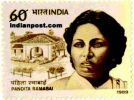
Here is an eyewitness account of the description of a Puranic family of ninteenth century of India. It is a part of autobiographical note of Saraswati Pandita Ramabai (1858 – 1922) as per the site of International Christian Women’s History Project (ICWHP) .

Postal Stamp of Pandita Ramabai issued in October 1989 in India

"Ever since I remember anything, my father and mother were always traveling from
one sacred place to another, staying in each place for some months, bathing in
the sacred river or tank, visiting temples, worshipping household gods and the
images of gods in the temples, and reading Puranas in temples or in some
convenient places.

The reading of the Puranas served a double purpose.
The first and the foremost was that of getting rid of sin, and of earning merit
in order to obtain Moksha. The other purpose was to earn an honest living,
without begging.

The readers of Puranas. Puranikas as they are called-
are the popular and public preachers of religion among the Hindus. They sit in
some prominent place, in temple halls or under the trees, or on the banks of
rivers and tanks, with their manuscript books in their hands, and read the
Puranas in a loud voice with intonation, so that the passers-by, or visitors of
the temple might hear. The text, being in the Sanskrit language, is not
understood by the hearers. The Puranikas are not obliged to explain it to them.
They may or may not explain it as they choose. And sometimes when it is
translated and explained, the Puranika takes great pains to make his speech as
popular as he can by telling greatly exaggerated or untrue stories. This is not
considered sin, since it is done to attract common people's attention, that they
may hear the sacred sound, the names of the gods, and some of their deeds, and
be purified by this means. When the Puranika reads Puranas, the hearers, who are
sure to come and sit
around him for a few moments at least, generally give
him presents. The Puranika continues to read, paying no attention to what the
hearers do or say. They come and go at their choice.

When they come, the
religious ones among them prostrate themselves before him and worship him and
the book, offering flowers, fruits, sweetmeats, garments, money, and other
things. It is supposed that this act brings a great deal of merit to the giver,
and the person who receives does not incur any sin. If a hearer does not give
presents to the Puranika, he loses all the merit which he may have earned by
good acts. The presents need not be very expensive ones, a handful of rice or
other grains, a pice, or even a few cowries, which are used as an invitation."

By Pandita Ramabai, Dated: March, 1907.


A General Comment:

In present days in India, you do not come across a pilgrim, who performs the work of a Puranic. However, on the other hand, there many Kathakars, Elucidators on Bhagvat Gita and other religious books like Ramayana etc. There are television channels exclusively dedicated to such speakers who address to their audience in different robes. In Sikh religion also, there are Patthis and Raagis who have taken up similar activity and enjoying a good audience. Whenever such people visit a city, there are big hoarding, showing their oversized faces produced with the latest technology in printing. They come to the stage in a grand manner. They are surrounded by such followers who readily give large amounts in charity. There are people who sponsor their visits to their cities. They put in to practice all the successful marketing and event organising skills and models when they perform their act of elucidation. They do not use Sanskrit much in their elaboration. They talk in a dialect which their audience can understand. Can they be called the present day Puranics???


Sources:
http://www.icwhp.org/ramabai.htm
The source claim that the writing has been borrowed from the official document issued by the Government of India in the year 1989, when the Indian Government issued a commemorative stamp on Pandita Ramabai and had also declared her the women of the millenium. Philatelic officer of Department of Post might have issued it. However, there is no counter proof to establish the authenticity of the account. Similarly, as per the account given there, the death of Pandita Ramabai is given as 1920. However, on numerous other sites, it is given as 1922. It creates some doubts. A review of the book of Pandita Ramabai by Meera Kosambi given on Vedams Books, the last year of her life is given as 1922. It is only that the description given about the Puranic seems to near to the truth, that the relevant description is reproduced above.


Photograph Source:
Wikipedia and Indian Post. On the India Post site, the details provided about the stamp does not contain the autobiographical essay as claimed by International Christian Women’s History Project (ICWHP).

October 19, 2006

Revised list of History Blogs on HNN

Monitor by Triambak at sumirsharma.blogspot.com
Ralph E. Luker has updated the blogroll on History News Network. It now contains around 500 blogs nicely grouped into categories. No doubt, Ralph E. Luker has imaginatively titled his revised list information as "You can’t Eat a Blogroll". However, there is need to comment that in this manner, one may get at one place the material for one own interest. The bonus is that it is being done intelligently and there are pertinent comments and there will be such citations and references which make it more useful.

I for the one have learnt a lot from the people who are online. I remember here John Simkin through whom I ventured on this method of communication. Soon I found that Internet was not all that easy place. Then came new devices like Wikis and Directories where you can find the relevant source material to substantiate your understanding or just read the opposite version. In addition to that you learn about other issues, topics and activities about which you could have not learnt because of limitation of your milieu.

Ralph has given a note on the latest addition. Apart from reference to AHA, a portal which I visited earlier but forgot to remember the exact name and groped with different phrases on search engines to locate it, there is reference to Digital Historians. Now apart from W Turkel blog, which already includes some highly heavy reference to fellow workers, I have new blogs to look at.

Further, he has added four blogs from Asia wherein this blog has found place. At the end of Cliopatria’s Appendices, it is stated as "Categories are an abstraction. Many blogs do not categorize well. We've done the best we can. Neither category, order or position are intended as value or quality judgements." It is quite an understandable noting on the work done by Cliopatria. My blog has been placed in the category of region. I have never intended to make it as blog of regional history. I had named it hurriedly because there was such exuberance at the time of making the blog that I never thought for why I am naming it as it is today. It was later, I specified that it would deal with philosophy of history, methodology and online resources. I consider historian a person without a nation. Rather, for a historian, the humanity is his nation. It is the time and space function as watched through records or sources which makes the historian. Thus the motive was specified in the header. However, the blog has found the place under a region category and specified as an Asian region blog. Well as far as my origin is concerned, I am an Asian. Secondly, after looking at the category and inclusion of the blog, I was made to review the overall character of my blog. I found that though I profess lofty ideas about my understanding of history, I have made more pertinent observation about one country, one place and a specific time period. In case of time period, I have remained true to my liking for eighteen and nineteenth century. No doubt, I have made comments about Gandhi Era and referred to Subhash Chandra Bose, Rabindranath Tagore, Mohd. Ali Jinnah and historiography on that period, but, calendars do not decide that a phase ends with the printed date. For India, 1947 has remained a nineteenth century. The calendar date may be a convenient reference but history makes it own time periods. It has made eighteen and nineteenth century interesting for me. It may not be same with others. As far as region is concerned, I think, now even the space time paradigm will change. Shooting off the tangent!! Ok, Let me break away at this point.

Anyhow, I will continue with my activity as such. I am coming up with more postings. I have completed reading of one of the book. (I make three to four reading of a book then I start making points. May be cognition and comprehension not all that good? But it is how I do it.) Now, I have a list of blogs through an authoritative source. It will help to remain in touch with the direction of new trends.

September 30, 2006

Percolation Through Blogging: Watched Two Approaches to History

Source of Knowledge: The Sun


While reading the comments of Kevin M Levin on the article of Manning, I observed with great amazement that how the topics of history are being debated and researched in America. They are taking the topic of Civil War quite seriously. They are debating and exploring different sources and methods to define and identify the cause of the event which is now popular as Civil War. Civil War is a chapter in American history, which is given great respect by the Americans. They are not ready to accept that it had actually taken place in America. They are debating that why it had actually happened at all. They are debating the issues which concerned the Southern states. They are trying to find out the reasons behind the various stands of Confederates. They are not satisfied with one or two observations. They want to explore all the issues from every possible angle. They are also trying to understand the responses of the Unionist approach to the contentions of the group which was definitely a part of America. They want to reason out for the course of the events as it had taken place.

I have located the blog of Kevin when he blogged on the blogger. Then he shifted to typepad because he did not find blogger quite comfortable or may be it did not live up to the expectations of a blogger who is a "a High School History Teacher and Civil War Historian -- Blogged Daily." It is from his blog that I have come across many other blogs which had taken the civil war as one of their main topic. Earlier, I was confined to Education Forum. Therein, mostly European teachers and research scholars debate on some selective issues. No doubt, many of the topics are concerned with American history. Their debate on assassination of JFK is quite popular. It was there, that I learnt that there were very few sources on Civil War. I was not satisfied with the observation. In their resource section, there were some links to many original sources for the period 1860 onwards. However, later I graduated and explored the web further. I myself started blogging in February 2005. During the course of blogging, I had come across many blogs which discussed the American history. It was through such blogs that I located many sources on American history.


Anyhow, the comments on the article picked by Kevin which he has assured will continue for sometime, has left me with different feelings. I am wondering that why similar type activity is not being taken in India. In India, it seems, that the history of India is settled and it is felt and assumed that there is no need for any such debate. There are many time periods in India which require lot of research and debate. It is in that debate that India can find the real definition of India. During 19th century, there are many such events which require deeper probe. If I try to make a list of such events, then I would like to begin with Anlgo Maratha War, treaty with Baji Rao II, English relations with Maharaja Ranjit Singh, the war activities of English in Burma and Afghanistan, the Sindh Occupation, the proverbial Uprising of 1857, the occupation of Punjab in 1849. I may pick some more events and add to the list. However, the year 1857 definitely stands out as the most important event. Recently, BBC carried out an interview with one William Darlymple. It is about his forthcoming book "The Last Emperor". There are three books by the same title which had already appeared. The interview of Darlymple had been greedily lapped up by the Pakistani bloggers. On the other hand, the Indian bloggers had adopted the same old Indian response of criticizing it. The author of the forthcoming Later Mughal had definitely passed some comments which are not appealing. He had come with the concept of Jihad in 1857. He had based his observation pointing out the number of times the words din and dharama had appeared in the archival material in India. The thesis of Manning is also a result of such discovery. She had studied the soldiers of both sections from the material discovered from archives. The topic and the construct which she had adopted was first mooted somewhere in 1940s as per the web site of the institution where she is working. However, her work is not criticised on the basis of the fixed notions based on the observations of one or two historians. There are strong reactions to what she had earlier told in her research as mentioned by Kevin. However, whatsoever, she is able to explore, it is being studied by the rest of the Americans with a balanced approach. However, such an approach is not undertaken in India.


In India, 1857 is cherished because it is called the first war of independence. The people seem to be satisfied with that much only. They are not ready to study in detail the event of 1857. I know that you can find number of titles in Libararies which are exclusively devoted 1857. I have explored them but none of them had even attracted me. They contain the same material and presented as per the ideology of the writer. The Indians are not ready to learn that what prompted the different sections of the society to participate in the uprising even if it had remained confined to North of Vindhyas. They are not ready to study the various streams of thoughts, push and pressures, constrains and expectations which moved the people to rise against the firangies. A set of historians had decided for them that the idea of nation had grown on 1870s. No body is trying to evaluate that how far it is true. They are not ready to define the idea of nation among the Indians. They are happy that it was there in 1870s and that is enough. But they are ready to accept that 1857 was the first war of Independence which was undertaken by the elite group and 1870s was the period of Middle Class which discovered and then consolidated the idea of Indian nationalism. Was there any chappati and Lotus mystery? You touch the point, you will be just snubbed. You will be told that it was a mere rumour and there were no proofs for that. Well, if Manning had not found the unattended letters of soldiers in archives, then even Americans would have said similar thing for the main motives of the Confederate Soldiers. Bill Wiley, an historian had told in 1843 that there was not enough material for such a type of study. Would the Americans have adopted that type of attitude and taken such a stand? I doubt. They would have found some other source to explore that what actually had happened in 1860. They are not satisfied by merely criticizing Bush and his Iraq policy. They are actually trying to study what they are and they do it by studying their history. However, in India, it is not so.

The Partition of India is also another such event in history of India which requires immediate and piercing attention of historians. It should be rather called the most important event which should be immediately taken up by the Indian historians. There are many constraints on undertaking such an activity because of the rigid or rather unconcerned approach of the government of India itself. The other reason may be the foreign relations with two immediate countries namely Pakistan and Bangladesh. However, the event of 1947 is old enough to qualify for the scrutiny of historic evaluation. There are many problems which have their root in 1947. However, we do not find that zeal and tenacity to deal with the study of 1947 from historic angle. Recently, there was an excerpt from the book of Kuldip Nayyar. Each line of the excerpt was a topic in itself that demands historic evaluation. Well that is not to be. Or shall we wait till the date when some foreign scholar come to our archives and then declare a theory about Indian Partition so that we may start are tirade against him and ultimately by commenting on him produce our own version of history of partition?

September 22, 2006

Born in San Francisco Memorial in Jalandhar


This post is about the web site of Ghadhar Party Martyrs Memorial. It is called Desh Bhagat Yaadgar.

Two Storey Building of Desh Bhagat Yadgaar Hall at Jalandhar, Punjab, India


Coming from Ludhiana, do not take turn to right from PAP. Remain straight. Pass by Lyallpur Khalsa College and cross the Railway Crossing. You are on the Sher Shah Suri Grant Trunk Road which is also National Highway no. 1. You have entered Jalandhar. Remain on the road and soon you will reach the traffic lights which was once a British Motors Company Chownk. It is not there now. Remain straight on the road. There will be a bend in the road and soon you will locate a Petrol Pump on the right hand side and a row of small shops which deals in second hand cars on your left hand side. That is the boundary of Desh Bhagar Yaadgar Hall. It is on your left hand side. The entrance is quite un-descriptive. Well, you can locate a two story building in rusty red colour on which ‘Desh Bhagat Yaadgar Hall’ is painted. However, if you look towards further on the left side of the building, you may find a stadium.

Enter from the gate before the row of second hand cars shops begins. You have to walk a distance of nearly ten meters and you will enter a hall. In the hall you will find nearly 212 photographs as claimed by the web site Desh Bhagat Yaadgar.

Well, do not expect any air conditioning. Being a big hall, it quite airy. On the left hand side, there is an office, where you may find an attendant. However, If you are adventurous enough to see the photographs on your own then it is really an experience of life. There are photographs. Some of them are well annotated but many of them are without any caption or name of the person whose photograph is displayed.


Who were they? Who were the people who are shown in those photographs? Well, they were the Ghadarits. They were the members of an organization or if one is not pleased to say it like this then a party which was founded in San Francisco. It was formed by Sohan Singh Bhakhna and Lala Hardyal. It was the next response of the Indian nation after Swadeshi Movement of 1905. It was not a single response. It was culmination of the responses of Indians who had left the shores of India due to different reasons. In 1907, Ramnath Puri issued a Cirular-e-Azadi. In 1908, Tarak Nath Das had come out with a paper Free Hindustan. The same year, G. D. Kumar started a paper Swadesh Sevak from Vancouver in Gurmukhi. In 1910, Tarak Nath Das and G. D. Kumar set up the United India House in Seattle in U. S. In 1913, they joined with Khalsa Diwan Society to start a combined efforts to fight for the rights of Indians who had reached the Pacific Coast in North America. Later, they were given a common war cry by a Sikh priest, Bhagwan Singh who taught them the slogan of Bande Mataram. Lala Hardayal further ignited a revolutionary streak among the Indians through his Yugantar Circular. Finally, all these efforts culminated into the "Hindi Association of the Pacific Coast" in Portland in May 1913. A Working Committee was established under the guidance of Bhai Parmanand, Sohan Singh Bhakhna, Kanshi Ram, Lala Hardyal and Harnam Singh ‘Tundilat’. That committee started the weekly paper called ‘The Ghadar’ and established a headquarter called ‘Yugantar Ashram’ in San Francisco. This group became more popular as the Ghadarist after the name of the newspaper which they published.
Yugantar Ashram, the Headquaters of The Ghadarit at 5 Wood Street, San Francisco
What did the Ghadarist achieve? Well, it is suffice to say that after Swadeshi Movement of 1905, and revolutionary activities of Bengalis, it was the revolutionary response of Punjabis. They finally ended up in Kalapani (Andaman Jails). The memorial is about those people who ended in Kalapani and returned from there, back to Punjab of pre-partition years. In order to preserve their memory and to help the members of their group, they founded a Desh Bhagat Parivar Sahyak Committee. After the partition of 1947, the committee registered itself under a fresh name called Desh Bhagat Yaadgar Committee. Sohan Singh Bhakhna became its founder president. They then desired to raise a memorial for their efforts for getting independence. They bought a land spread over 3 acres in Jalandhar in 1955. Now a building stands there with the photograph of their members who had come to India in February 1914 to free it from British Imperial Rule.


It is hoped that a visit to the site by research scholars, student of history and the general netizens will be a rewarding experience.


Source:

Additional notes are taken from Bipin Chandra and five authors, "India’s Stuggle For Independence", Penguin India, 1989, pp 146-149.


Photographs source: Web site of "Desh Bhagat Yadgaar Hall, Ghadar Party Martyrs Memorial at Jalandhar, Punjab, India at http://www.ghadarmemorial.com/index.html

September 21, 2006

Single History Department in India


Menhir Rock in the campus of Hyderabad University

WAIT!!


Do not React Sharply.

Kindly read what I write below.


Center of History and New Media on its Resource page claims a "Searchable database linking to roughly 1,200 history departments around the world. If a department has a web site, it’s here."(Lines in original taken from <http://chnm.gmu.edu/resources/> retrieved on September 21, 2006.)

In the above mentioned data base of 1200 sites of History Departments; and mind it that the CHNM claims that if there is a web site of a history department then it is there, there are 351 sites of History Departments from non-US location. These 351 sites are from rest of the world and every other continent is represent in that set. It also shows that there are 849 web sites of History Departments from within United States.

Out of 351 sites from non-US area there is only one site from India. It is a site of Department of History, School of Social Science of University of Hyderabad .


The site is maintained by Dr. Rekha Pande and Dr. MN Rajesh .


There are thirteen links on the site providing information on the Department, Faculty, Alumni, Funding etc. Among various facilities, the department claims to use computer based technologies as well as the Information Technology. In its future plans, the department proposes to start new courses like History of Information and Aesthetics, Gender History and such more programmes. In the link on "Recent Activities" they have displayed their activities. They may also start the digitization of rare sources and archives. However, there is nothing like original resources, display of original work by the department and digital sources on the line of democratization of Knowledge as it is being practiced by various history departments from US and many other countries.

On the whole, it was heartening to find that India is represented in the list of 1200 sites. The Hyderabad site is using ERNET resources, which is part of the project of EDUSAT in India that promotes the e-learning. But on the other hand, it is depressing to note that there is only one university in India and one Department of History who are able to understand the real meaning of the new technology and ICT. I have been writing about this aspect after deriving ideas and models from other universities. However, I was pained to learn that there are mere talks about e-learning and digitization of resources in India. I have browsed the sites of Punjabi University, Patiala, Punjab University, Chandigarh in its latest form, PTU Jalandhar, Kurushetra University, Thanesar, Gurukul Kangadi University and some more universities. They have made a link each on department of history. However, there is no separate site of the Department. I have made similar comments on Digital Library of India. In case of Delhi University, you find good material on the courses being run in the department of history. But this is no separate site of the department.


On the whole, I congratulate the University of Hyderabad as well as the Department of History of the University of Hyderabad for their vision and ability to learn and practice the real dimensions of the new technology. They have fulfilled an important requirement of EDUSAT programme and NAAC. I hope that they may soon improve upon their effort and bring some original work done by the department in digital form on the site itself which is an essential feature of the department sites of foreign university. This feature of digitization has imparted a concrete meaning to the activity of maintaining the site so that it can be made useful for the rest of the society. A simple web site does not fulfill any substantial purpose. It merely becomes an additional source of information about the existence of an identity. It does not achieve much by a mere display of a site. It becomes a ritual then and Indians are good in performing rituals and forgetting the real purpose of an act. It is then counted as a mere fad and commercial act of promoting oneself on cyberspace which profit seeking identities are undertaking in far better manner. I borrow the motive of the site of the History Department Around the World of CHNM and quote, "We hope that this list will help you find ideas for creating departmental web pages, let you look in on or locate colleagues, conduct historical research, or help out with a graduate or undergraduate application." (Retrived in original from <http://chnm.gmu.edu/resources/departments/>on September 21, 2006.) This quote can convey the real purpose of such activities. In addition to that they may also encourage their illustrious faculty to write regularly on the site or through their own blogs about the projects they are undertaking and give the links to their weblog on the site itself. It will make the site more useful and popular.

Sources:

Photograph source: Web site of Department of History, School of Social Sciences at http://www.uohyd.ernet.in/sss/dhistory/newindex.htm of University of Hyderabad at http://www.uohyd.ernet.in/uohyd.htm

September 18, 2006

Delineating Gandhi Influence in Forming India – A Case in Gender Studies


I have posted on this blog two posts directly referring to the place of Gandhi in Indian History. I have written an essay titled "Why Was Gandhi not Given Noble Prize" and then other one titled, "Need of Rewriting the Gandhi Era".

My main argument is that there is need of rewriting the Indian history. Somewhere, J Mills model has taken hold of the interpretation of Indian history which was later molded for the benefit of the group which took over the reigns of the government after the independence of India. The three stages of Indian History as described by J Mills History of India did not go away even after adopting the new nomenclature of Ancient, Medieval and Modern. The idea of nationalism, right and left wing groups, the Marxist, then Lenin, Gramasci and followed by Economic history interpretations thrown in, the overall shape of the history as it has emerged in present day India, is not serving the country called Republic of India. It becomes really a bad episode with highly ominous ramifications when one socio-political group that latter emerged as a strong sect followed by their claim to be a separate religion is termed as a terrorist organisation in the books by NCERT (A typical case of faulty interpretation wherein twenty century concepts were imported to seventeenth century.). The cause of such stupefying acts is that somewhere we need a fresh interpretation of Indian History because there is no such interpretation which was meant for the people of India. It should not be called rewriting. Rather it will be the first attempt in writing the history of India.

Anyhow, I am here with a small noting on the role of Gandhi in defining the role of a group in the life of India borrowed from a book written on that very group or the section of the Indian society. However, I am afraid, that such comments, wherein in the word "Gandhi" is appearing again and again may not be taken as Gandhi Bashing. That is definitely not the aim of all such writings. The main theme is that India should look at the records of her past now, that is, after getting independence in 1947 when she has established herself a nation with a reckoning. Now, this should also not be taken as a revisionist history. For me, there is no question of revisionist history because the history of India as being in existence today was never written for the Indians. The theory of history with which India has preserved her past was rejected because the history based on the function of time and space was based on definition of history brought by western schools. I am not against the western schools. I am rather bred and taught as per the guidelines of the western schools of history. For me that was a new learning. It was that learning that told me that there exists another theory also by which the history can be recorded. In addition to that, if we have to write history as per the western schools of history, then it is not there at all.

In short, I am definitely not indulging in Gandhi Bashing. No. Not at all.

I propose that the Indian history has to be written and the history of India as it exists today is what has been written by non-Indians for a particular period and with a particular purpose. It was not written with the purpose of writing history of India for the subject History.

British authors had written history of America for the understanding of the people of Britain. But the Americans had written history of America for the Americans. If that makes my point clear, then I continue with purpose with which I am writing this post.

The main theme of this post is an observation by Geraldine Forbes on the role of Gandhi in defining the Women participation in Indian history in her book ‘Women in Modern India'.

The relevant lines has been taken from her book titled ‘Women in Modern India'

The lines are as follows.

" …, Women began asking for their rights before they were brought into the nationalist agitation. The women involved in the women’s movement justified their new roles with the ideology of social feminism, that, they tied their arguments about women’s right to women’s obligation to perform traditional roles and serve the needs of the family. Although conventional wisdom credits Gandhi with bringing women into public life, I would argue that they were already there. Gandhi gave them a blueprint for action. Equally important, Gandhi assured their husbands and gathers that these politically active women would not rebel against the family."


Well, first of all, the fact which is emphasised here is that women had already defined their role in relation to political power even before Gandhi had given his "blueprint" to them. This is not evaluated in Indian history. The author of the book has already written about the problem of getting the material for the women in India whereas there were enough evidences that the Indian women had been influenced by the social policy of British company and then the Crown. She has differentiated between the aim of the British policies and the role which the women played in the colonial milieu. One has to just remember the name of Rani Lakshmi Bai and then recollect the role of different women before 1919. The only problem is that their role has not been studied and also due to patriarchal social setup, the desired sources are not available. It can be best explained by a case of Raja Rammohan Rai and his legal battle with his mother Tarini Devi.

The second important point which has been emphasised is that it is a conventional wisdom that it was Gandhi who brought the women in the nationalist movement. The author has proved in her book, that this role of Gandhi, which is already an established fact, requires right wordings to describe it because the participation of women before Gandhi is also a fact.

As far as the view of the historian on the role of Gandhi in convincing the patriarchal leaders of the society is concerned, the author has explained it in the book but there is need to evaluate it further. I will just refer to an incidence from the Rani Jhansi. When she was faced by controversy over the issue of legal heir with her in-laws on one hand and the Britishers on the other, she had declared that "Mein Jhansi Nahin Doongee". There is no doubt, that there was strong control of the male members on the Indian women. There were social restrictions which could never be broken by a common woman. But this is one side of the story. The fact is that it is not only the male mind set which has to be changed while researching in sphere of gender studies, even the mind set of the women researchers also requires a reformatting of their mind set so that they can rightly evaluate the role of other different women. No doubt, the problem is big because there is lack of right historic sources, which increases this problem. But on the whole, we have to break some of the conventional wisdom which now we are carrying about the Indian history.

September 15, 2006

Blog Ban Revisits

It is nearly 3.30 pm in India. I am trying to access blogger blogs and typepad blogs. I am not able to access them.

It seems that the incidence of July 14, 2006 is being repeated. If the other bloggers are also encountering the same problem in India, then kindly raise your voice again. It seems that the people who matter, have not learnt the right lessons.


The Follow Up Reporting is made at Jitters.

September 10, 2006

Microfilming of Indian Publications Project

MIPP or Microfilming of Indian Publications of Project is a joint venture of the Government of India under Ninth Five Years Plan and the Library of Congress.

From the site:
"Microfilming of Indian Publications Project (MIPP) is preserving and making accessible all 55,992 books listed in The National Bibliography of Indian Literature: 1901-1953 (NBIL) together with the pre-1954 titles in the NBIL supplement. These are books in the twenty-two major languages of South Asia selected by a group of Indian scholars for their central importance to humanistic understanding of India
As of April 2000, 22,000 titles have been microfilmed. More than 18,000 of these books are fully cataloged and can be searched through the NBIL search page at DSAL or through the Center for Research Libraries' catalog."


In a lighter vein, this is outsourcing of the Process by the Government of India which is funded by U.S.-India Fund for Cultural, Educational, and Scientific Cooperation. Since our childhood, we are told that the Germans took away our original sources and made major scientific advancements. Now here, I feel delighted that this projected has been envisaged and under execution. It is stark reality of Indian intellectual world that only elite groups access the archives. There are many constrain on the scholars from school and colleges to access such source material if they desire to undertake some serious work. With the digitization of sources and coming of the Internet, some respite can be felt by such starved scholars.

The need of such a project has been listed on the site. It is undertaken to overcome three major shortcomings namely high demand, paucity of holdings and low quality of paper.

Further, many more libraries have joined the project after finding the activity meaningful. The project has been first suggested by National Library of India, Kolkata. A detailed profile of project is given covering different aspects of the project on the site.

The site forms the part of the Digital South Asia Library. They have not only performed the job of preserving the South Asian literature in different languages but also catalogued it and then made it available in digital form. I have located different issues of Social Scientist on DSAL. One can read the issues of the journal from the year 1971 onwards. The last issue available on the site is of 2001, vol. 344-45

The students, research scholars and historians will find it useful to explore the site and find many original sources, books in different languages, maps and statistical data fully categorized according to time scales.

Mumbai: A City with a History


The history as a subject is merely confined to the text books and quiz contest culture. Well, no apologies for such an observation on a blog of history by a student of history living in India. Here, the idea is not to give any new finding or interpretation on the process of urbanization or the emergence of an identity as a city. No doubt, such a study is required because any city is a place of habitation of humanity and such a study is required to understand that place of habitation. It is required by the habitants of the city for their ‘social common sense’ or their ‘common consciousness’ and especially for those who are born in the city and lived through its various stages of development and also for the people who are entrusted with the responsibility of its bureaucratic administration.

Anyhow, this post is made to identify a source of information (which is one of the aims of this blog) which is well presented covering a whole period of existence of a habitation. It may be useful for the people interested in quiz culture, or writing an essay in a school or giving an introduction in a seminar or writing an introduction to a souvenir or pamphlet.

The source identified is titled as ‘Bombay: History of a City’ given on the portal of British Library in its section Learning and sub section Trading places.

The writeup gives a historic detail of the possession of the place presently know as Mumbai named after the goddess of deep sea fishermen, Mumba devi since 1995. It refers to the origin of its early name as Bombay. Bombay was a English utterance for Portuguese’s word Bom Bahia which meant ‘the good bay’. From then onwards, the article trace in brief the transfer of Bombay to Charles V and then its renting out to East India Company in 1668. The efforts were made by the British traders to establish an urban center on the dowry of their royal landlord on the model of London which they had tried to establish in London after the Great Fire of 1666. It came under the siege of Mughal army in 1688 due to trading practices of the British company and the company lost its trading privileges for sometime because at that time Royal Mughal more mightier than the trading company. However, soon after, the British Company restored itself to dominance because those were the years of the passing out of the Mighty Mughal Royalty. In the early years of 1700, Bombay emerged as the Gateway of India by serving as the trading center for the British Trading Company. From then onwards, started the saga of rise of Bombay first as the trading then later as manufacturing center in South Asia.

The article is brief but it has very nicely trapped the whole development of Mumbai. It is embellished with details on population and trading activity for specific period. On the whole, it is a nice, brief but proportionate. However, there is a touch of peculiar Cambridge histrographic tradition in referring to some specific incidences and details.

September 07, 2006

Latest "The Last Mughal" is arriving in October 2006


There is a report on Sify.com by Vishal Arora from Delhi. It is titled "New Twist to 1857 mutiny debate". It is surprising to read that for Arora the Uprising of 1857 was an event which has to be either identified as a Mutiny or a First War of Independence. Anyhow, the report is about a forthcoming book of William Dalrymple.

According to this report William Dalrymple has come out with a research work spread over four years and the result will be in form of a book titled "The Last Mughal". It is just a coincidence that my last post was about the Last Mughal Emperor Bahadur Shah Zafar whose song "Na Kisi ki Ankh Ka Noor Hoon, Na Kisi kay Dil Ka Karar hoon" made famous in the silken voice rendered to his poetry by late Mohammad Rafi. He is definitely becoming a "Dil Ka Karar" with great Shidad after 142 years.

Well, the book is not in my hands. It will be released, as reported in the above mentioned report, in the month of October 2006. However, there are some details about this book which are given in the above mentioned report.

The first feature of this book mentioned in the report is that Darlymple had reached conclusion that the 1857 event was a "war a religion due to concerns over British intentions to impose Christianity".

Darlymple has, it is emphasized, reported in an interview on BBC that he had consulted nearly 20000 documents of the rebels now preserved in National Archives of India. The documents are in Persian and Urdu. He was assisted by Mahmoud Farooqi in gleaning and evaluating the documents. The documents were recovered from the Sepoy Camp and the Palace in Delhi.

A question was asked from the historian that whether the missionaries were a separate identity and opposed by East India Company. The historian had explained the position of missionary in British East India Company in the year 1857 and reported to 1833 Charter. Though the historian has not specifically mentioned the Charter and the report only records that the historian had told that the missionaries were legally allowed in East India territory in 1830s. He seems to have categorically stated that after that "missionaries and Church building were both patronized by the company. This was a major cause of the uprising of 1857."

In report a very important statement has been attributed to the celebrated historian which is the major contention against the Indian historians till this day. It is said that "up to now most of the data used by historians exploring 1857 has come from British source." The historians clarified that the papers in National Archives has never been properly explored before. There may be a truth in that observation.

It is further written that the historians told in the interview that the war of religion was linked to the foreign domination. He had substantiated by referring the war cry of the rebel sepoys which consisted the word Din and Dharma in danger. He also emphasised that other concerns like self-government and economic freedom had found little mention in their documents and the main concern had remained about the imposition of Christianity by the British edifice.


A very peculiar observation is made in the report. The historian is reported to have said that the main rebels were the upper class Hindus because of the composition of the infantry at that time and they were later joined by freelance Jehadis. Further, in a categorical statement, he has reported to have told that "There are clear and specific references among the Mutiny Papers to a regiment of jihadis arriving in Delhi from Gwalior who are described as suicide ghazis who had vowed never to eat again and to fight until they met death at the hands of the kafirs". Then he has further reported that the sepoys indulged in prosecution of Christian converts during the course of uprising. He has pinpointed a specific case of Chaman Lal, a Christian convert living in Delhi. It will be of interest to note that how he has referred to such an observation in his book.

However, the report ends on a very fascinating note. The BBC has sought answers to questions about present affairs of India on socio-religious level. The historian has given his opinion also. Anyhow, this report has attracted my attention and I found it worth recording on my blog.

There is need to direct the attention of the readers to an article by Prof. R. K. Khanna at Uprising in 1857.

In addition to that the BBC interview with William Darlymple can be accessed here. It is worth reading it. As far I am concerned, I am not amused with the contents given in there.

Being a student of history, I must say that history should not be used as a propaganda material by using dialectics. Is there any conspiracy against India? The Ghost of J. S. Mill is still alive. The Shradas has started in India from today that is September 7, 2006. The United Kingdom must do some thing about this Ghost.

September 06, 2006

Using Historiography to emphasis an Ideological Stand


V. N. Dutta, Professor Emeritus, is a regular columnist in Spectrum, a Sunday section in The Tribune published from Chandigarh. He writes the column "Off the Shelf". Earlier he was quite regular. His reviews of different books were surfeited with scholarly comments. Last year, his reviews were full of literary references even of the book of literature wherein he was seen departing from discussing the history books and taking up the books from literature. However, this year his column is not appearing regularly. As one can assume that he has advanced in age and may be he is not keeping up with the editorial demands of the publication. Even the last review, one before the last Saturday, did not carry the stamp of V. N. Dutta genre.

Last Saturday, that is September 3, 2006, he wrote a review on "The Last Emperor" by S. Mahdi Husain, republished from Delhi. The first edition was published in 1956. While recollecting the event of the publication of the book in 1956, Prof. Datta referred to an incidence which prompted Husain to publish the biography of the Last Emperor. I reproduce the whole paragraph verbatim below:


"The impulse to the writing of the biography of Bahadur Shah originated from the controversy that had aroused between the author and the doyen of historians, Dr R. C. Majumdar. The author wrote an article, Emperor Bahadur Shah II and his Role in the War of 1857, in Amrit Bazar Patrika, November 18, 1956. In this article, Husain had emphasised that Emperor Bahadur Shah was a staunch patriot. Fired by a passionate zeal, he fought for the freedom of his country from the fetters of foreign rule. Husain also maintained that the War of 1857 was the war of independence and not a mere sepoy revolt, as is commonly known. Ten days later, on November 28, 1956, Majumdar, contesting Husain’s views rebutted that only one epitaph fitted suitably to Bahadur Shah, and that was treachery. In other words, Bahadur Shah was a traitor who betrayed the sepoys. Husain took Majumdar’s criticism as a challenge and brought out this comprehensive work on Bahadur Shah."

After making a point above, Prof. Datta carried out the dissection of the book from the point of historicism and methodology. However, I am here with comments of different genre.

It is rather a continuity of my earlier argument which I have presented in my earlier post titled "Need of Rewriting Gandhian Era". The question here is the actual interpretation of Indian history rising above the ideological affiliation and the biases which were quite strong in the middle of twentieth century India. There is need of rewriting the history of India from Indian perspective. I remember, as a young student of history at undergraduate level I was amused to read the controversy debated between A. L. Srivastva and S. R. Sharma over the episode of marriage between Jahangir and Nurjahan. I read their books to prepare my notes for my examination. But when I reached the chapter of Jahangir, I was put into difficulty to choose this episode for my notes. They had discussed this issue over three to four pages. I was not able to decide whether I should write any notes on them or would there be any question on it. When I discussed it will by Professor, I did not give any straight forward answer. He rather discouraged me. He told me not to consult A. L. Srivastva as he was branded as Hindu minded biased historian. I did not have the understanding and knowledge to understand what he was telling me. I still remember that I did not obtain good marks in Mughal History paper. The boys, who had consulted the question answers books (The Refreshers or Kunjees as it is called in India), obtained better marks than I did. I had virtually licked each and every line of S. R. Sharma and A. L. Srivastva. One of my friends who knew that how far I had mastered this subject mocked at me for my method of study. Well that is other story. The issue is that the historians debate among themselves over such issues in such a manner which can not be included under the subject of history. In history, a historian should remain confined to the source material and say only that much which had been written in the original sources. If he has to pass any judgement, then the historian should also write there the counter view. However, it is found that historians indulge in an activity of settling scores with their fellow historians and write history accordingly. This damages the interest of history as well of the interest of those people or nation about which it is written.

It is not one single episode. There is another episode in the Indian historiography. There was similar fight and debate between R. C. Majumdar and Tara Chand. Tara Chand was deputed to write the history of India, especially the Freedom Struggle of India. Earlier this job was to be given to R. C. Majumdar who had already accomplished a big task in 1951 under the patronage of G. D. Birla for Bhartiya Itihasa Samiti with funding from Shri Krishnmarpan Charity Trust headed by G. D. Birla, an industrialist known to be close to Gandhiji. Later, the ruling party Congress entrusted this job to Tara Chand. They had accused Majumdar for being near to Jan Sangh group and a non-secular historian.

Similarly, a few years back, Irfan Habib was ousted from the ICHR on the grounds that he was a Marxist historian. In response, Irfan Habib came out with his book of essays wherein he countered many concepts and views being promoted by the historians in his absences.

Similarly, Sumit Sarkar has come out with his own book titled Writing Social History. I have not yet completed the reading of this book. Therein, I am developing this impression that the essays are intentionally collected to counter a particular form of historiography. Though in such type of books, sometimes you are not able to understand the direction of debate. May be one is not all that well informed as well as well read as these established authors are.

Another examples which comes to mind is the book, the Last Mughals and the profile of Bahadur Shah I. One is just amused to read that how S. R. Sharma tried to counter the impression about Bahadur Shah I as created in the Last Mughals.

On the whole, such types of exercise by the historians to project an event in history with counter views and then indulge in obscurantism by obfuscating a historic personality or an event does a great a disservice to the subject. I am really excited when I find some original sources online which is made available by this new technology of Internet. My faith in my own view of Internet as a good source of discussing history through collecting of sources available online was further reinstated when I read of an invitation to Miland Brown by the Encyclopaedia Britannica. It helps you to see for yourself the real content of the source and derive the exact picture of an event or a personality.

I here again take another example. Since our school days we were taught that Aurangzeb was a religious bigot and fundamentalist. It was taught that he used to take his supper only after collecting a maund of sacred threads of Hindus. Later, in the book of J. L. Mehta, a letter by Aurangzeb was reproduced. The contents of that letter project Aurangzeb in a different colour. Similarly, an attempt was made for sometime to project Aurangzeb as a milder person than what he was earlier projected in the history books. Now, at present stage, when I read more and more about Indian history, I always thing over that how a particular aspect of history would be taught in Pakistan. Will they project the same version? It is then, I feel that there is need to rewrite the history.

Dr. S. Radhakrishnan


Sarvepalli Radhakrishnan was born in Tirutani on September 5, 1888 into a poor brahmin family. The name of his father was Sarvepalli Veeraswami. His mother's name was Sitamma.

Sarvapalli Radhakrishnan started his teaching career in year 1909 at the age of 21 years from the post of Assistant Lecturer in Madras Presidency College, Tirupati.

In year 1918, he was selected to the post of the Professor of Philosophy in the University of Mysore. It was there he published his first book titled "The Philosophy of Rabindarnath Tagore". Before that his thesis at post graduate level was published. The title of his thesis was "The Ethics of the Vedanta". After that he had published numerous articles in the various world renowned journals of Philosophy. His second book was "The Reign of Religion in Contemporary Philosophy" published in 1920. In 1921, the Vice Chancellor of Calcutta University nominated him George V Professor of Philosophy. In 1923, he published his book "Indian Philosophy". It was rated as the masterpiece in the field of literature and philosophy. This book fully established him as the leading intellectual of world. He was later called to England to deliver lectures at Oxford University. He was appointed there as Professor of Religion and Ethics. It was during his stint that he had spoken for the cause of freedom of India. He spoke, "India is not a subject to be administered but a nation seeking its soul." In 1931, he was elected to the post of Vice Chancellor of the Andhara University. He restructured the university and made well recognized institution in the field of social and general sciences and technology. In 1939, he took over as the Vice Chancellor of Benaras Hindu University founded by Pandit Madan Mohan Malvia. The Benaras Hindu University survived and flourished only because of Sarvapalli Radhakrishanan efforts.

In 1948, he was asked to chair the University Education Commission. It was under his guidance that the Indian Education system of independent India was re-framed.

In 1949, he was deputed as an ambassador to Soviet Union which was under Stalin at that time. From 1948, he represented on numerous cultural bodies of United Nations Organization (UN).

In 1954, Bharat Ratan was conferred upon Dr. Radhakrishanan. He became the President of India in 1962. It was during his tenure that India fought her two major wars namely with China in 1962 and then with Pakistan in 1965. It was during his tenure that Nehru passed away. Two famous Indian prime ministers Pandit Nehru and Lal Bahadur Shastri ruled under his presidentship.

He expired on May 17, 1975 at Madras.

Some of the Major episode of the life of Dr. S. Radhakrishanan.

Sarvapalli Radhakrishnan was born in an orthodox Brahmin family. However, he completed all this education in Christian missionary schools and colleges through scholarship. He completed his high school from Lutheran Mission School in Tirupati. He completed his graduation and post graduation from Madras Christian College Vellore.


While at Madras Christain Missrionary College, young Radhakrishanan was undecdied about the choice of subject for his honours course. He was expected to choose from Mathematics, Physics, Biology, History and Philosophy. It was a mere incidence that one of his cousin who had completed his graduation course with honours in philosophy, passed on to him three well known books on Philosophy. Radhakrishanan read those books mere out of curiosity and finally decided to opt for Philosophy as an honours course at graduation level.


In 1914, the world renowned Mathematics genius from India Srinivas Ramanuja visited Sarvapalli Radhakrishanan to seek his blessing for leaving for his studies in Cambridge. He approached him with the message that Goddesses Durga had directed him in his dream to seek his blessings before leaving India.

Ashutosh Mookerjee, the Vice Chancellor of Calcutta University was highly impressed by the articles and books of Sarvapalli Radhakrishanan. He nominated him to the post of King George V Professor of Philosophy at Calcutta University in 1921. It was a highly prestigious assignment.

Prof. J. H. Murihead requested Sarvapalli Radhakrishanan to write a readable account on Indian Philosophy which could be included in the Library of Philosophy. Radhakrishanan completed a mammoth task of writing on Indian religion within two years and published the book "Indian Philosophy" in two volumes in year 1923. The book is still rated as "philosophical classic and a literary master piece".

Sarvapalli Radhakrishanan was invited to Oxford University to deliver "Upton Lecture" on ‘The Hindu View of Life’. Later a special chair was established for him and he was appointed as Spalding Professor of East Religion and Ethics at Oxford.

In 1929, Sarvapalli Radhakrishana succeeded Principal J. Estin Carpenter in Manchester College, Oxford.

He was knighted in 1931 and bestowed upon the title of ‘Sir’. He was then called Sir S. Radhakrishanan. He was called by that title till 1947. After that he was addressed as Dr. S. Radhakrishanan.

In 1931, he was invited to head the Andhara University as Vice Chancellor. He resurrected the university by restructuring the departments of language, Humanities, Science and Technology. When he left the university in 1936, Andhara University had earned the position of the leading universities.


In 1939, he took over as the Vice Chancellor of Benaras Hindu University established by Madan Mohan Malaviya. In 1942, the Governor Sir Maurice Hallet tried to convert the campus of University into a war hospital during the Quit India Movement. Radhakrishanan approached the Viceroy and stayed the conversion of campus for other purposes. However, Sir Maurice Hallet responded by holding back the grant to the University. Sir Sarvapalli Radhakrishanan launcehd a ‘Begging Pilgrimage’ and collected funds for the university. The university continued to work in that manner. After that Madan Mohan Malaviya retired from the university. The university requested Sir Sarvapalli Radhakrishanan to continue in his post for infinite time.


Savapalli Radhakrishanan was appointed as an ambassador to USSR in 1949. He was invited by Joseph Stalin to meet him in Kremlin. It was an unexpected invitation because such a meeting was never part of the protocol. It is on record that referring to his infamous bloody purges, Radhakrishanan suggested a role model of Asoka to Stalin. Stalin listened him and responded back with a smile. He was able to establish direct rapport with Stalin who was being hated by rest of the world at that time. When Radhakrishanan was called back to India in 1952, he met Stalin before leaving and had very intimate conversation with Stalin. It touched Stalin deeply and even wished him a long life. The political analysts believe that the role played by Radhakrishanan in Moscow had laid the grounds for better relation with USSR.

During his two terms as Vice President of India, whereby he acted as the Chairman of Rajya Sabha, his period is remembered for tactful handling of sensitive debates in Rajya Sabha. His role as the Chairman of Rajya Sabha is remembered for the Sanskrit Shalokas and quotations from Bible which he readily used while defusing the tension generated during the debates in the house.


More than 100 honorary degrees and nearly 10 D Litt had been conferred upon him.

President Dr. S. Radhakrishanan spent his last days at his house ‘Girija’ Mylapore, Chennai.

Comments and Quotations by and about Dr. S. Radhakrishanan.

Dr. Sarvapalli Radhakrishanan was a monist in philosophy, monotheist in religion, eudaemonist or perfectionist in Ethics and socialist in politics.

Another profound scholar and leading politician Dr. Shanker Dayal Sharma, when took over as the President of India, it was popular in intellectual circle that a person that could revive the glory of President of India as raised to a height by Dr. S. Radhakrishanan, had come become president.


Professor A. G. Hogg of Madras Missionary College while commending the post graduate thesis of Sarvapalli Radhakrishanan titled "The Ethics of Vedanta and Its Metaphysical Presupposition" wrote, "The thesis which he prepared in the second year of his study for this degree shows a remarkable understanding of the main aspects of the philosophical problems, a capacity for handling easily a complex argument besides more than the average mastery of good English".

Aldous Huxley had remarked about Radhakrishanan that he "is the master of words and no words". It refers to his ability to express the most abstruse thoughts of philosophy in such a fine language that it becomes comprehensible to all.

Prof. H.N. Muirhead said, "Dr. Radhakrishnan has the rare qualification of being equally versed in the great European and the not less great Asiatic tradition which may be said to hold in solution between them the spiritual wisdom of the world, and of thus speaking as a philosophical bilinguist upon it."


George P. Conger said, "Among the philosophers of our time, no one has achieved so much in so many fields as has Sarvepalli Radhakrishnan of India … ."

Further, "With his unique appointment at Banaras and Oxford, like a weaver's shuttle, he has gone to and fro between the East and West, carrying a thread of understanding, weaving it into the fabric of civilization."


Sources: Former Presidents of India A Government of India Web Site. The readers will get details of all the awards conferred upon and works done by Dr. S. Radhakrishanan.


University of Memphis Web Site This link displays a handwritten letter by Dr. S. Radhakrishanan. It is part of the web site of University of Memphis at http://www.cs.memphis.edu/ .

Bangali Net of Bangali Net.

Hinduism Today


Edit Log:
Date: September 5, 2007.
Added the new link to official Presidents of India Official site. It was done because the original site has undergone reframing after the election of the new President Honourable Smt. Pratibha Devsingh Patil. Those who are visiting this post (for one last week, there is a tremedous rush), are requested to check the original site at http://presidentofindia.nic.in/ and then seek the link on left hand sidebar of the website if they are not able to access the site directly from this blog.

Contact Form

Name

Email *

Message *