This post is about the web site of
Ghadhar Party Martyrs Memorial. It is called Desh Bhagat Yaadgar.
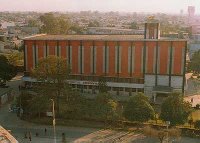
Coming from Ludhiana, do not take turn to right from PAP. Remain straight. Pass by Lyallpur Khalsa College and cross the Railway Crossing. You are on the Sher Shah Suri Grant Trunk Road which is also National Highway no. 1. You have entered Jalandhar. Remain on the road and soon you will reach the traffic lights which was once a British Motors Company Chownk. It is not there now. Remain straight on the road. There will be a bend in the road and soon you will locate a Petrol Pump on the right hand side and a row of small shops which deals in second hand cars on your left hand side. That is the boundary of Desh Bhagar Yaadgar Hall. It is on your left hand side. The entrance is quite un-descriptive. Well, you can locate a two story building in rusty red colour on which ‘Desh Bhagat Yaadgar Hall’ is painted. However, if you look towards further on the left side of the building, you may find a stadium.
Enter from the gate before the row of second hand cars shops begins. You have to walk a distance of nearly ten meters and you will enter a hall. In the hall you will find nearly 212 photographs as claimed by the web site Desh Bhagat Yaadgar.
Well, do not expect any air conditioning. Being a big hall, it quite airy. On the left hand side, there is an office, where you may find an attendant. However, If you are adventurous enough to see the photographs on your own then it is really an experience of life. There are photographs. Some of them are well annotated but many of them are without any caption or name of the person whose photograph is displayed.
Who were they? Who were the people who are shown in those photographs? Well, they were the Ghadarits. They were the members of an organization or if one is not pleased to say it like this then a party which was founded in San Francisco. It was formed by Sohan Singh Bhakhna and Lala Hardyal. It was the next response of the Indian nation after Swadeshi Movement of 1905. It was not a single response. It was culmination of the responses of Indians who had left the shores of India due to different reasons. In 1907, Ramnath Puri issued a Cirular-e-Azadi. In 1908, Tarak Nath Das had come out with a paper Free Hindustan. The same year, G. D. Kumar started a paper Swadesh Sevak from Vancouver in Gurmukhi. In 1910, Tarak Nath Das and G. D. Kumar set up the United India House in Seattle in U. S. In 1913, they joined with Khalsa Diwan Society to start a combined efforts to fight for the rights of Indians who had reached the Pacific Coast in North America. Later, they were given a common war cry by a Sikh priest, Bhagwan Singh who taught them the slogan of Bande Mataram. Lala Hardayal further ignited a revolutionary streak among the Indians through his Yugantar Circular. Finally, all these efforts culminated into the "Hindi Association of the Pacific Coast" in Portland in May 1913. A Working Committee was established under the guidance of Bhai Parmanand, Sohan Singh Bhakhna, Kanshi Ram, Lala Hardyal and Harnam Singh ‘Tundilat’. That committee started the weekly paper called ‘The Ghadar’ and established a headquarter called ‘Yugantar Ashram’ in San Francisco. This group became more popular as the Ghadarist after the name of the newspaper which they published.
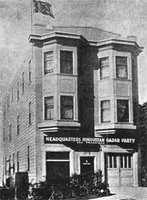
What did the Ghadarist achieve? Well, it is suffice to say that after Swadeshi Movement of 1905, and revolutionary activities of Bengalis, it was the revolutionary response of Punjabis. They finally ended up in Kalapani (Andaman Jails). The memorial is about those people who ended in Kalapani and returned from there, back to Punjab of pre-partition years. In order to preserve their memory and to help the members of their group, they founded a Desh Bhagat Parivar Sahyak Committee. After the partition of 1947, the committee registered itself under a fresh name called Desh Bhagat Yaadgar Committee. Sohan Singh Bhakhna became its founder president. They then desired to raise a memorial for their efforts for getting independence. They bought a land spread over 3 acres in Jalandhar in 1955. Now a building stands there with the photograph of their members who had come to India in February 1914 to free it from British Imperial Rule.
It is hoped that a visit to the site by research scholars, student of history and the general netizens will be a rewarding experience.
Source:
Additional notes are taken from Bipin Chandra and five authors, "India’s Stuggle For Independence", Penguin India, 1989, pp 146-149.
Photographs source: Web site of "Desh Bhagat Yadgaar Hall, Ghadar Party Martyrs Memorial at Jalandhar, Punjab, India at
http://www.ghadarmemorial.com/index.html




 Posts
Posts


